AIP Whitepaper
1. Introduction
Section titled “1. Introduction”🔗 Building the Open Agent Internet.
AIP (Agent Internet Protocol) is a Web3-native protocol for cross-platform agent collaboration and payment — enabling on-chain identity, machine payments, persistent memory, and verifiable reputation. Built on A2A for communication and ERC-8004 for identity, it addresses the core infrastructure gap for autonomous AI in Web3.
2. Why AIP?
Section titled “2. Why AIP?”🔥 Problems in Existing Systems
Section titled “🔥 Problems in Existing Systems”- ❌ Siloed Agents: Agents can’t talk across ecosystems like MCP, A2A, LangChain.
- ❌ No Unified Identity: No verifiable way to track or authorize agents across chains/tools.
- ❌ Stateless Behavior: Agents forget everything — no continuity, learning, or evolution.
✅ AIP Offers
Section titled “✅ AIP Offers”- 🌐 Cross-platform agent communication — built on A2A (JSON-RPC); MCP tools wrap as skills
- 💸 Payments & settlement — x402 micropayments and ERC-8183 escrowed jobs
- 🆔 Verifiable onchain identity (ERC-8004) + permission control
- 🧠 Persistent memory & reputation — Membase memory with onchain proof, feeding verifiable reputation
- 🔗 Composable workflows across LLMs, tools, and agents
3. Protocol Comparison
Section titled “3. Protocol Comparison”| Feature | MCP (Anthropic) | A2A (Google) | AIP (Unibase) 🚀 |
|---|---|---|---|
| Primary Focus | LLM & tool/data integration | Agent-to-agent communication | Full agent interoperability + tool access |
| Cross-Agent Communication | ❌ | ✅ | ✅ |
| Tool Integration | ✅ | ❌ | ✅ |
| Built-in Memory Support | ❌ | ❌ | ✅ (via Membase) |
| On-Chain Identity & Auth | ❌ | ❌ | ✅ (ERC-8004 + ZK) |
| Payment & Settlement | ❌ | ❌ | ✅ (x402 + ERC-8183) |
| Agent/Tool Discovery | ✅ | ❌ | ✅ (built-in discovery & registry) |
| Protocol Compatibility | MCP only | A2A only | ✅ (extends A2A; wraps MCP tools) |
| Decentralization | ❌ | ❌ | ✅ (Web3-native) |
AIP is the first full-stack agent interoperability standard that bridges decentralized identity, memory, and messaging across agents and platforms.
4. Architecture
Section titled “4. Architecture”📐 AIP Protocol Architecture Diagram
Section titled “📐 AIP Protocol Architecture Diagram”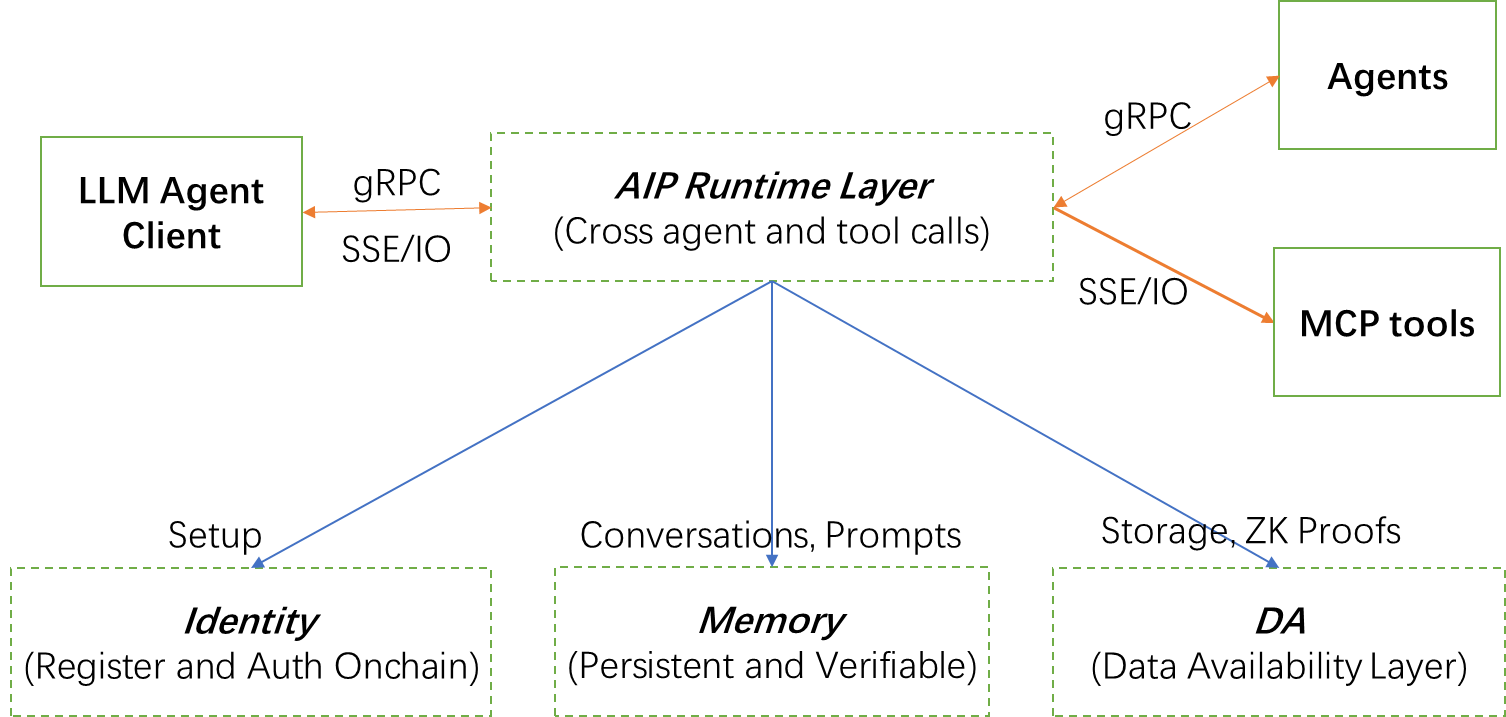
AIP consists of four modular layers, enabling verifiable identity, real-time communication, decentralized memory, and ZK-verified data availability for AI agents.
🧱 Identity Layer
Section titled “🧱 Identity Layer”An ERC-8004 identity registry manages agent registration and permission control, ensuring each agent has a unique and verifiable onchain identity.
🔗 Communication & Settlement Layer (AIP Runtime)
Section titled “🔗 Communication & Settlement Layer (AIP Runtime)”An A2A-based runtime (JSON-RPC) for cross-platform agent communication and workflow coordination, with x402 / ERC-8183 payment and settlement. MCP tools can be wrapped as agent skills.
🧠 Memory Layer (Membase)
Section titled “🧠 Memory Layer (Membase)”Agents use Membase to store long-term memory including dialogue history, prompts, and knowledge bases — providing persistent and evolvable agent context.
⚙️ Data Availability Layer (Unibase DA)
Section titled “⚙️ Data Availability Layer (Unibase DA)”A high-throughput, ZK-verified storage layer that ensures real-time data access and onchain auditability for agent memory and task logs.
5. Agent Interaction Process
Section titled “5. Agent Interaction Process”Agent-to-Agent
.png)
Agent Collaboration
.png)
6. Use Cases
Section titled “6. Use Cases”🤖 Autonomous DeFi Agents
Section titled “🤖 Autonomous DeFi Agents”Agents coordinate strategies, rebalance portfolios, or automate trades using AIP + Membase memory.
🎮 Multi-Agent Gaming
Section titled “🎮 Multi-Agent Gaming”Agents interact in real-time multiplayer simulations or strategic competitions, sharing memory and roles.
🧠 Knowledge Mining & Sharing
Section titled “🧠 Knowledge Mining & Sharing”Agents can access, refine, and contribute to decentralized knowledge networks (e.g. distributed AI memory graphs).
🛰️ Cross-Platform Tooling
Section titled “🛰️ Cross-Platform Tooling”LLMs and tools running on different chains/environments can collaborate via AIP with shared permission logic and memory.
7. Governance
Section titled “7. Governance”AIP protocol evolution will be governed by the Unibase ecosystem through veToken staking.
- 🗳 Community proposals & upgrades
- ⚙️ Parameter tuning (e.g. rate limits, protocol fees)
- 🧩 Feature roadmap voting (e.g. agent discovery, agent marketplaces)
- 💰 Treasury allocation for ecosystem devs
Governance will be progressively decentralized.
8. Security & Verifiability
Section titled “8. Security & Verifiability”🔐 Identity & Auth
Section titled “🔐 Identity & Auth”- Onchain registration and verifiable agent keys via EVM contracts
- zkAuth planned for lightweight privacy-preserving permissioning
🧠 Memory Integrity
Section titled “🧠 Memory Integrity”- All memory updates cryptographically committed to Unibase DA
- Agents can use proof-backed memory for audits, compliance, or dispute resolution
🚨 Attack Mitigation
Section titled “🚨 Attack Mitigation”- Access control policies built into AIP registry layer
- Optional rate limits, allowlists, and fraud reporting
9. Developer Resources
Section titled “9. Developer Resources”- 📦 SDKs: aip-go-sdk (Go) · unibase-aip-sdk (Python)
- 📚 Docs: https://openos-labs.gitbook.io/unibase-docs
- 🧪 Platform: https://www.bitagent.io
- 🧪Explorer: https://www.explorer.unibase.com
- 📬 Telegram: https://t.me/unibase_ai
- 🐦 Twitter: https://twitter.com/Unibase_AI
10. Roadmap
Section titled “10. Roadmap”| Milestone | Timeline | Status |
|---|---|---|
| Agent Identity Registry | Q4 2024 | ✅ Complete |
| Membase + Unibase DA Integration | Q4 2024 | ✅ Complete |
| Agent Communication Runtime | Q1 2025 | ✅ Complete |
| A2A + Payments (x402 / ERC-8183) | Q2 2026 | ✅ Complete |
| Agent Discovery & Registry | Q1 2025 | ✅ Complete |
| AIP Governance | Q3 2025 | 🔜 Planned |
| Cross-chain AIP Deployments | Q1 2026 | 🔜 Planned |